A Brief Introduction to R by Hugh C. Pumphrey is licensed under a Creative Commons Attribution-ShareAlike 3.0 Unported License. Also note that to do the examples you will need these files:
This is not Hugh's real home page. If you want to see that, you'll find it over here , in the School of GeoSciences zope-tastic web site. This page began merely as a test to investigate what the School's web servers export to the world, and how they do it.
Having found out that we have zope-free home pages, I initially used them to expose to the world a few files that I change often and which I can't be bothered to upload to the School website every time I change them. But I find entering material into Zope to be sufficiently tiresome that I am now using this page to put some of my research and other interests onto the web. There is also a full list of my papers.
I was lead author on the validation paper for the MLS CO measurement. The reference for this is
Hugh C. Pumphrey, Mark J. Filipiak, Nathaniel J. Livesey, Michael J. Schwartz, C. Boone, Kaley A. Walker, Peter Bernath, Philippe Ricaud, Brice Barret, C. Clerbaux, R. F. Jarnot, L. J. Kovalenko, Gloria L. Manney, and Joe W. Waters. Validation of middle-atmosphere carbon monoxide retrievals from MLS on Aura. Journal of Geophysical Research, 112, D24S38, doi:10.1029/2007JD00872, 2007.
I retrieved HCN mixing ratios from the MLS measurements. The signal strength is very low so I used weekly zonal mean radiances to retrieve weekly zonal mean mixing ratios. The work is described in this paper:
Pumphrey, H.C., C.J. Jimenez, J.W. Waters, Measurement of HCN in the middle atmosphere by EOS MLS, Geophys. Res. Lett.33, L08804, doi:10.1029/2005GL025656, 28 April 2006.
You can get the data here but you should note that the normal HCN product is much better since we released version 4.
The main thing that I have discovered with this data is a tape-recorder effect in HCN: you can read about it in this paper
H. C. Pumphrey, C. Boone, K. A. Walker, P. Bernath and N. J. Livesey, Tropical tape recorder observed in HCN, Geophys. Res. Lett 35, L05801, doi:10.1029/2007GL032137, 2008
There is much more HCN in the atmosphere during a major El-Niño event. You can read about that in this paper:
H. C. Pumphrey, N. Glatthor, P. F. Bernath, C. D. Boone, J. Hannigan, I. Ortega, N. J. Livesey, and W. G. Read. MLS measurements of stratospheric hydrogen cyanide during the 2015-16 El Niño event. Atmospheric Chemistry and Physics, 18, 691-703, doi:10.5194/acp-18-691-2018, 2018.
I wrote a paper on the observations made by MLS of various chemical species
which were injected into the stratosphere by the catastrophic bush
fires of February 2009.
The paper is published in Atmospheric Chemistry and Physics;
this is an open journal so you can just click to download it. The
full reference is:
H. C. Pumphrey, M. L. Santee, N. J. Livesey, M. J. Schwartz, and
W. G. Read, Microwave Limb Sounder observations of biomass-burning products
from the Australian bush fires of February 2009,
Atmos. Chem. Phys 11, 6285-6296, (2011)
It turns out that the MLS instrument can observe the large blob of water vapour that is dumped in the upper mesosphere / lower thermosphere by the space shuttle's main engines. My paper on this subject is now published in its final form in Atmos. Meas. Tech. This is an open access journal so anyone can download it. The full reference is: H. C. Pumphrey, A. Lambert, and N. J. Livesey, Observation of the exhaust plume from the space shuttle main engines using the microwave limb sounder, Atmos. Meas. Tech. 4, 89-95, (2011).
... or "whoops, we mapped the galaxy again". I wrote a paper on this in Advances in Space Research; the reference is:
Hugh C. Pumphrey, Richard E. Cofield, Mark J. Filipiak, and Nathaniel J. Livesey. An all-sky survey at 230 GHz by MLS on Aura. Adv. Space Res., 43(3), 342-348, doi:10.1016/j.asr.2008.11.010 Feb 2008.
If you don't have on-line access to Adv. Space. Res., you can get a late pre-print from the University of Edinburgh's research archive or you can ask me for the author's "personal use" copy of the final version.
I wrote the first paper describing the MLS observations of SO2 in the stratosphere from volcanos. The reference is:
H. C. Pumphrey, W. G. Read, N. J. Livesey, and K. Yang. Observations of volcanic SO2 from MLS on Aura. Atmos. Meas. Tech., 8:195--209, 2015. [ DOI ]
The MLS SO2 data has also been used in a paper describing similar observations from the MIPAS instrument. Since those papers were written there has been another significant eruption which I describe briefly in a blog post .
I've been interested in these for a while. I'm not a serious observer, but I report any that I see to the observers homepage . I have set up a plot of temperature and water in the mesosphere over the UK as a guide to when clouds might be observed.
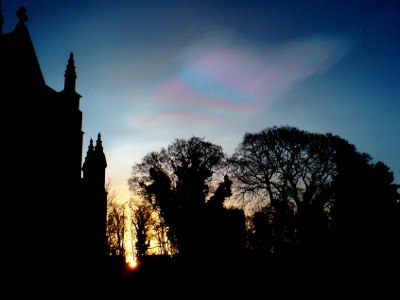
These are the clouds in the lower stratosphere on which the reactions occur that destroy Ozone. The generic term for them is "polar stratopheric clouds"; they are called nacreous clouds when observed from the ground. I have set up a plot of temperature and water in the mesosphere over the UK as a guide to when clouds might be observed.
The R code for my zonal energy-balance model is here. Save it to disc in whatever way your browser does that and run it in the usual way by typing source("tk_hsmcg.R") at the R prompt. You might also want the instructions.
The R code for my grey-atmosphere radiative-convective model is here. Save it to disc in whatever way your browser does that and run it in the usual way by typing source("grey_1d.R") at the R prompt. You might also want the instructions.
... including some simple gravity models in R
I have set up an automatically-updated plot of the reported weather at Edinburgh airport (airport code EGPH).
I have set up a crudely generated map and animation of the last 24 hours weather.
This document started out as an "Introduction to IDL." I became annoyed with the proprietary nature of IDL and tried some free alternatives. I tried re-writing the notes as both an introduction to R and an introduction to Matplotlib. The matplotlib version never got further than a first draft, but the R version was used for a number of years as part of a now-defunct M.Sc in remote sensing, and is therefore somewhat well tested. You can get the notes for all three languages below, but only the R notes are really to be recommended.
If you want to
use the R notes, please note that
A Brief Introduction to R by Hugh
C. Pumphrey is licensed under a Creative Commons
Attribution-ShareAlike 3.0 Unported License. Also note that to do
the examples you will need these files: